
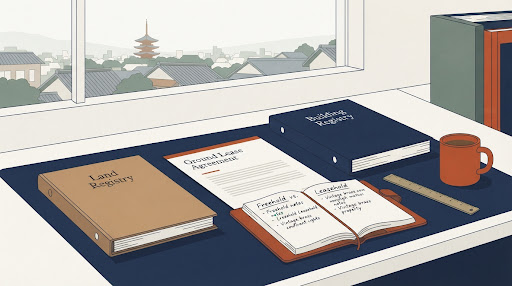
Sometimes you buy the house and rent the ground it stands on
In Japan the land and the building are separate pieces of property, and they can have different owners. A listing that looks unusually cheap for its location is sometimes selling you the building and a right to use somebody else's land.
In short
- Land and building are separate property in Japan, registered separately and capable of separate ownership.
- Rebuilding, extending, selling or mortgaging a leasehold building generally needs the landowner's consent, and consent normally has a price.
- Older leaseholds and post-1992 leaseholds behave very differently. Which one applies changes the value substantially.
Two things, not one
Most legal systems treat a house and its land as a single item. Japan does not. The land is one piece of property and the building is another, each with its own registry entry, and each capable of being owned, sold and mortgaged independently.
This produces a category of property that overseas buyers rarely anticipate: you buy the building, and with it a right to use the land, while the land stays with somebody else. You pay ground rent for as long as you hold it.
It is common in older urban districts and around temple land, and it is a legitimate, long-established arrangement. It is simply not the thing most buyers think they are buying.
Why the price looks attractive
A leasehold property is cheaper than the equivalent freehold, sometimes substantially, because you are not acquiring the land. That is the whole of the discount and it is rational.
What has to be set against it:
- Ground rent, payable indefinitely, and revisable
- Consent fees, at several points in the life of the property
- Harder to finance. Lenders treat leasehold as weaker security
- Harder to sell. Your buyer faces the same constraints, and needs the landowner's consent to take the transfer
The consents are where the cost sits
This is the part that is not obvious from the price.
| What you want to do | Position |
|---|---|
| Transfer the leasehold with the building | Generally requires the landowner's consent. A fee is customary |
| Rebuild or substantially alter | Generally requires consent. A fee is customary |
| Mortgage the building | Practically requires the landowner's cooperation |
| Renew at the end of the term | Depends entirely on which type of leasehold it is |
Where consent is unreasonably withheld, the court can in some circumstances grant permission in its place. That is a route, and it is a litigation route with cost and time attached.
Every significant thing you might want to do with the building involves asking a person who did not agree to sell you anything.
Old and new leaseholds are different instruments
Japanese leasehold law was substantially reformed with effect from 1992, and leaseholds created before and after behave differently. Which regime applies to the property is the single most important question about it.
| Created before the 1992 reform | Created after | |
|---|---|---|
| Renewal | Strongly protected in favour of the leaseholder. In practice these continue | Depends on the form chosen |
| Fixed-term forms | Not available | Available. At the end of a fixed term the land is returned, usually cleared |
| Effect on value | Closer to a durable interest | A fixed-term leasehold has a defined end date, and the value declines toward it |
The row that matters most is the middle one. A fixed-term leasehold ends. At the end of the term, the arrangement is generally that the building is removed and the land is handed back. If forty years remain, that is a long time; if twelve remain, you are buying an asset with a known expiry and a demolition obligation attached to it.
Establish which type it is, and if it is fixed-term, how many years remain. Both are documented.
The ordinary problems get harder
Everything else on this site applies to a leasehold property as well, and several things are worse.
Where the plot cannot be rebuilt on, the building carries the entire value, and on a leasehold you do not even have the land as a residual. The building is genuinely all there is.
Maintenance matters more for the same reason, and how a neglected building deteriorates is not different because the land belongs to somebody else.
And the relationship itself is a factor. You will be dealing with the landowner for as long as you own the property, at a distance, in Japanese, on matters where they hold the position of strength.
What to establish before you offer
- Is this freehold or leasehold? Check the registry entries for land and building separately
- If leasehold, was it created before or after the 1992 reform?
- Is it a fixed-term form, and if so how many years remain?
- What is the ground rent, when was it last revised, and on what basis?
- What consent fees are customary here for transfer and for rebuilding?
- Has the landowner consented to this sale, in writing?
- Who is the landowner, and are they an individual, a company or a religious institution?
- Are there arrears of ground rent attaching to the property?
- Is the building registered in the seller's name? Registration of the building is what allows the leaseholder to hold the right against a new owner of the land
Question six is the one to settle first. A leasehold sale where the landowner has not agreed to the transfer is not a sale yet.
All of this should appear in the pre-contract explanation, which is the document that covers rights and encumbrances. If you take away one habit from these guides, let it be reading that document before the day it is read to you.
What this article does not decide
Leasehold terms, ground rent, consent practice and customary fees are set by the individual contract and by local practice, and the applicable law depends on when and how the right was created. Nothing here describes the position under any particular lease.
This is general information, not legal advice. Take the actual documents to a lawyer or a judicial scrivener. En Beau lo is not a licensed real estate broker and introduces qualified professionals where they are needed.
It is not a trap, it is a different asset
Leasehold property is bought and sold in Japan every day, and for the right buyer at the right price it works. A long-established leasehold in a good urban location, at a discount that reflects the constraints, is a reasonable purchase.
The mistake is pricing it as though it were freehold because the listing did not make the distinction clear in a language you read. The discount is not a bargain. It is the value of the land, which you are not getting.
Land and building are separate records
We check what the registry holds for both, alongside zoning, hazard designations, terrain and access, and set out in your language what the documents actually say about the rights attached to the property.
Ask us to check a propertySources and notes
Land and buildings are separate items of property under Japanese law and are registered separately under the Real Property Registration Act. Rights to use land for the purpose of owning a building, their renewal, and fixed-term forms arise under the Act on Land and Building Leases, which took effect in 1992 and altered the position for rights created after it; rights created before continue to be governed in substantial part by the previous legislation. Court permission in place of a landowner's consent is available in defined circumstances under the same Act. Consent fees follow local practice rather than statute.